
North Port Tree Removal Pros has been doing stump grinding in North Port, FL for 20+ years, serving surrounding cities including Port Charlotte, Plantation, Englewood, Rotonda, Punta Gorda. The grind itself is the easy part of this job. What decides whether it goes well is the ground underneath, the access to it, and what you intend to do with that spot afterward.
Two decades on this coast teaches one lesson a machine brochure never will: here the limit on a below-grade cut is water rather than rock. A seasonal high water table sitting a foot or so down turns the working face into wet sand that will not stack, loads the wheel, and makes a rubber-tired machine on a saturated flat a restoration problem rather than a nuisance.
So we quote a depth we can actually hold at your address, and we say what happens to the grindings, the crater and the roots in the same breath. Haul-away and gate fees sit on their own line, because the horticultural waste gate rate changes at every county line we cross and North Port has no inbound tipping gate of its own.
What a Stump Grind Leaves Behind
Below-Grade Cut Depth, and What Sets It
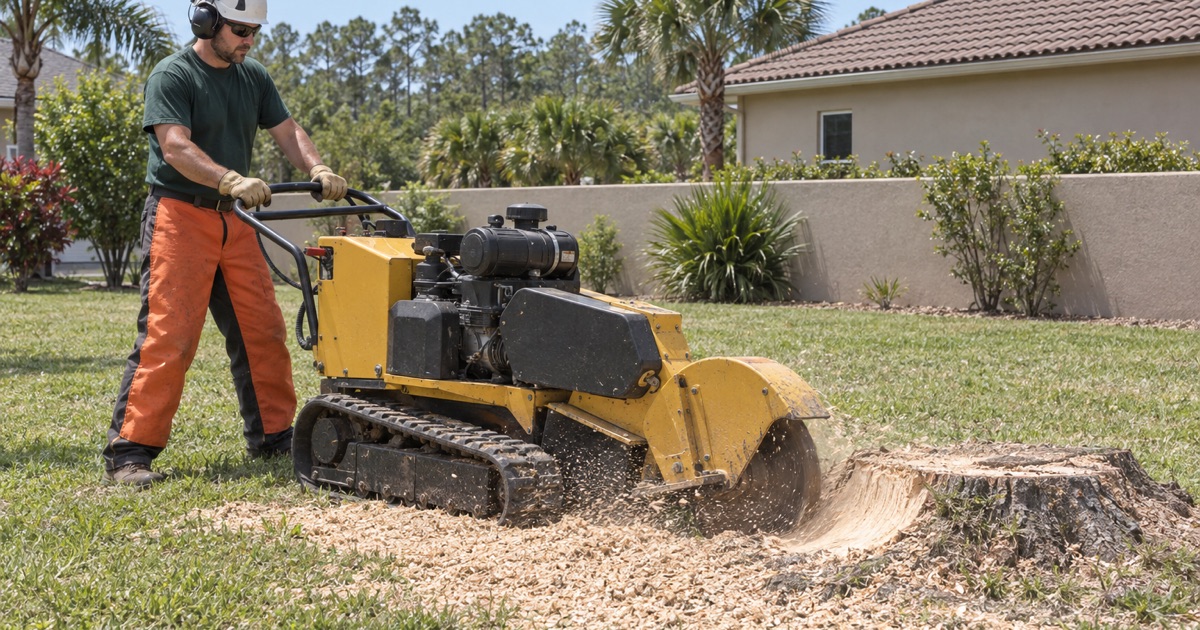
A stump grinder’s rated cut is a geometry figure, not a promise about your yard. Wheel diameter, machine travel and where the operator can stand all move it, and so does the stump itself: a wide flare on a live oak means several passes and a much larger hole than the trunk diameter suggests. We set a target depth against what you are doing with the spot, because turf needs less than a planting pit and a slab needs excavation rather than grinding at all.
The Grindings: Volume, Chemistry and Where They Go
A grind produces far more spoil than people expect, because wood chips mixed with sand occupy roughly twice the volume of the stump they came from. That spoil is acidic, low in available nitrogen while it decomposes, and it keeps settling for about a year. Shoveled back into the hole it buys a sunken, dead patch; hauled out and replaced with clean fill it buys a spot you can plant. Both options go on the quote with their prices.
Backfill, Settlement and Replanting in the Same Hole
If a new tree is going in, the hole wants clean fill and not the remains of the old one, and the new tree usually wants to be offset a few feet rather than centered on the old root crown. Where an irrigation head or a paver edge sits at the rim, we finish the backfill proud of grade by a small margin so the inevitable settlement lands level instead of low.
Water, Not Rock, Is the Limit Here
The Seasonal High Water Table
Much of this ring sits on poorly drained fine sand with a seasonal high water table close to the surface for months at a stretch. When the working face is in saturated sand the wheel packs, the spoil slumps back into the cut, and depth costs several times what it costs in a dry month. That is not a reason to refuse the job, it is a reason to schedule it honestly and to tell you which depth is realistic in August.
Myakka and EauGallie Sands, and the Spodic Horizon
The soils named across this area include Myakka fine sand and EauGallie fine sand, both of which carry a spodic horizon, a dark organically cemented sand layer that an operator can feel through the machine. It generally sits deeper than a stump grind reaches. At North Port’s own mapped profile, a Pineda fine sand, there is no spodic layer in the grinder’s band at all, so we read the soil survey for the address rather than carrying one lot’s assumption to the next street.
Rutting a Saturated Flat
On wet ground the damage that costs money is not to the stump, it is to everything the machine crossed getting there. We plan the approach on plywood or mats where the turf is soft, keep the spoil pile off the route rather than driving through it twice, and where the ground simply will not carry the machine we say so and come back, because a set of ruts across a front lawn is a landscaping bill attached to a stump job.
Grinding Against Full Removal of the Root System
When Grinding Is Enough
For a lawn, a bed, a fence line or a patch of mulch, grinding the stump and the flare is the right answer and the lateral roots can be left to decay in place. They are not going to resprout once the crown and the root collar are gone on the species we deal with here, and digging them out would disturb several times the area for no gain you would ever see.
When the Roots Have to Come Out
A footing, a slab, a pool shell, a driveway replacement or a retaining wall is a different question, because decaying roots under a structure become voids and voids become settlement. That is excavation with a machine and a truck rather than a grind, and it is priced that way. We will tell you which one your project needs before quoting, since paying for extraction you did not need is as wasteful as grinding where extraction was required.
Palms, Root Balls and Sabal Stumps
A palm stump is a dense fibrous ball rather than a tapered woody root system, and it behaves differently in the machine: less tearing, more packing, and frequently a cleaner hole. Sabal palm boots can persist well below grade and mask the true diameter at the base, so a photo underestimates the work about as often as it overestimates it. We price a palm stump after looking at the base.
Access, Obstacles and What Stops a Machine
Gate Width, Fence Panels and Pool Decks
Access decides the machine, and the machine decides the price. A narrow self-propelled grinder gets through most residential side gates; anything wider means a panel comes off and goes back on, which we quote rather than improvise. Around a pool deck or a paver patio we work off the hard surface only where it is rated for it, and mat the rest.
Irrigation, Low-Voltage Lighting and Buried Utilities
Utility locates cover the public lines and nothing on your side of the meter, which is exactly where the expensive surprises live: irrigation laterals, valve boxes, landscape lighting, invisible fencing, pool plumbing and the downspout drain somebody buried a decade ago. We locate the public lines, walk the area with you for the private ones, and expose anything doubtful by hand before the wheel goes in.
Concrete, Pavers, Septic and Everything Cast In
Stumps next to concrete often have roots under the slab, and grinding to the edge is the limit unless the slab is coming up anyway. Near a septic tank or drain field we keep the machine off the field entirely, because compaction there is a repair nobody wants attached to a stump. And stumps with fencing, cable, nails or a concrete collar cast into them get hand-cleared first, since one pass through hardware ends a wheel.
Our Step-by-Step Stump Grinding Process
1. Look at the Base, Not the Photo
We measure the flare rather than the cut face, check the species, probe for hardware or concrete, and note what the spot is going to become. That is what produces a price that does not move later.
2. Locate, Protect and Set the Route
Public utilities located, private lines walked with you, the approach matted where the ground is soft, and the work area screened so the discharge stays off the cars, the windows and the pool.
3. Grind to the Agreed Depth
The wheel works the stump and the flare down to the depth on the quote, in passes rather than one bite, and the operator watches the face for water and for anything the probe missed.
4. Spoil, Fill and Clean Finish
Then the choice you already made: spoil raked level in place where that is fine, or hauled out with clean fill in and the area raked, blown and left ready for turf, mulch or a new planting.
- 20+ Years on This Coast
- Free Written Estimates
- Dated Condition Reports