North Port Tree Removal Pros has performed arborist tree risk assessments in North Port, FL for 20+ years, serving surrounding cities including Port Charlotte, Plantation, Englewood, Rotonda, Punta Gorda. An assessment here is a written, dated document rather than a verbal opinion at the curb, because in Florida that document is what a permit exemption, an insurance file and a neighbor dispute all eventually run on.
Florida issues no state arborist or tree contractor license, so the word on a truck door tells you nothing by itself. What carries weight is the framework the statute actually names: an International Society of Arboriculture certified arborist or a Florida licensed landscape architect, working to the ISA Best Management Practices Tree Risk Assessment Second Edition 2017, which is also the body of work behind the Tree Risk Assessment Qualification.
That framework is what separates an assessment from a sales call, because it can return a recommendation to keep the tree. We will say so and quote the pruning, the cabling and bracing or the root work instead, and the reasoning goes in writing either way. Twenty-plus years across Sarasota, Charlotte and DeSoto counties is also what tells us which rule reaches your particular address before a word of the report is written.
What a Tree Risk Assessment Actually Measures
Level 1, Level 2 and Level 3 Assessments
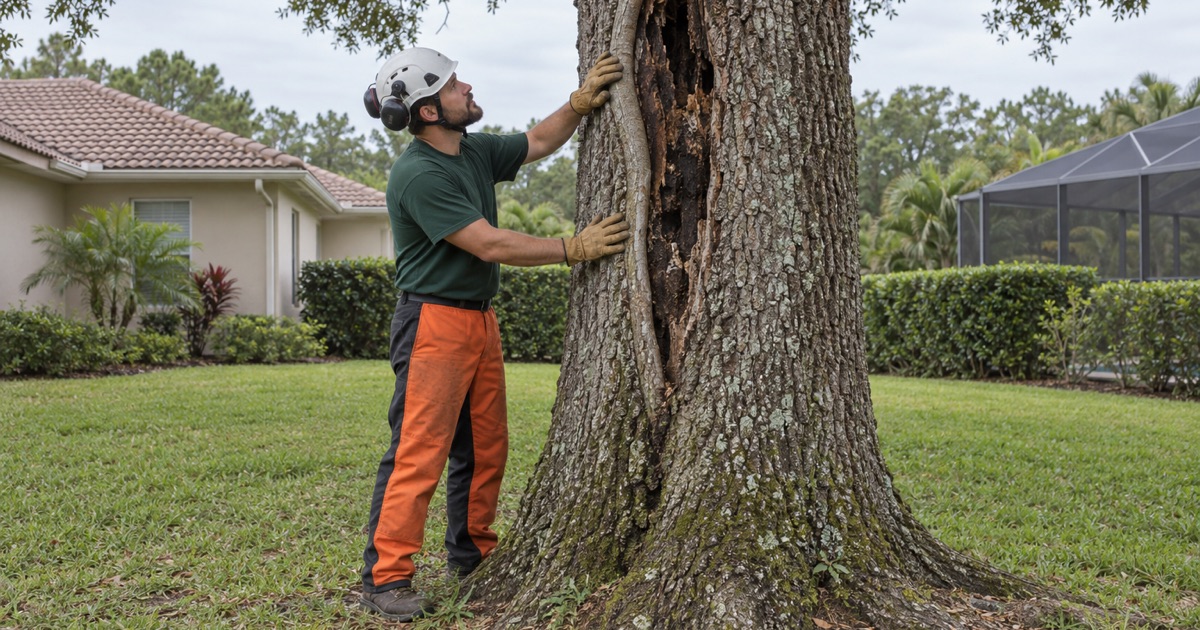
A Level 1 assessment is a limited visual pass over many trees, useful for a community looking for the obvious failures across a common area. A Level 2 is the basic assessment most single-tree questions need: a full ground inspection, all sides, base to crown, with probing and sounding. A Level 3 adds advanced tools where a Level 2 finding stays ambiguous, and it is scheduled and priced as its own visit rather than bundled in by default.
Likelihood, Impact and Consequence Are Three Separate Questions
Risk is not the same as defect. The assessment rates how likely the part is to fail, how likely it is to strike something if it does, and how bad that strike would be, and the three combine into a rating. A hollow laurel oak over open pasture and the same tree over a screen pool cage carry identical defects and completely different risk, which is why the target under the tree is measured as carefully as the tree.
The Written, Dated Condition Report
Every assessment leaves a written, dated report in plain language: what was inspected, what was found, the rating, the recommended action, and the residual risk if nothing is done. Dating it matters more than people expect. A report is evidence of the condition on a particular day, so one written before a storm says something a post-storm opinion cannot, and one written before a removal is what the statutory exemption is built around.
The Defects We Look For on This Coast
Root Plate Movement and Root Collar Decay
The most consequential findings here are at the ground rather than in the canopy. Soil mounded or cracked on the side opposite a lean, turf torn at the base and a root plate that moves under load are anchorage failures in progress. Where decay is suspected at the root collar we open it with a root collar excavation and an air spade rather than a shovel, because a shovel wounds the buttress roots that are holding the tree up.
Included Bark and Co-Dominant Stems
Two stems of similar diameter rising from one point, with bark turned inward at the union instead of a raised branch collar, is the classic failure geometry on live oak and laurel oak. The union never forms a proper wood connection, so it separates under a wet canopy or a gust. We measure the union, look for cracking and seam movement, and report whether it is a candidate for a reduction cut, a cable, or removal.
Palm Findings a Hardwood Checklist Misses
A palm has no cambium, no annual ring and no way to compartmentalize decay, so almost every hardwood indicator is irrelevant and the real signals are elsewhere. We read bud and spear condition, trunk penciling from a past period of stress, any basal conk pointing at Ganoderma butt rot, and previous cuts into the crownshaft. Reporting a palm against an oak checklist is how a dead palm gets called healthy for another year.
Arborist Documentation and Florida Statutes Section 163.045
What the Statute Requires, and in What Order
Florida Statutes section 163.045 stops a local government from requiring notice, application, approval, permit, fee or mitigation to prune, trim or remove a tree on residential property where the owner possesses documentation from an ISA-certified arborist or a Florida licensed landscape architect showing the tree presents an unacceptable risk. The order is the part people reverse. The documentation has to exist before the work, not be produced afterward to explain it.
Where the Exemption Stops
The statute was narrowed to single-family detached buildings on lots actively used for single-family residential purposes, so condominiums, townhouses, duplexes and vacant lots fall outside it entirely. It does not reach mangroves, which have their own act, and it does not excuse work in a right-of-way or inside a canopy road zone. Where it does not reach, a vegetation removal permit is the route, and we say which of the two you are in before quoting.
Protected and Heritage Trees Inside North Port
At a North Port address the city’s own ULDC sets the thresholds. A slash pine, longleaf pine, live oak or laurel oak becomes a protected tree at twelve inches diameter at breast height, a sabal palm at four and a half feet of clear trunk, and any native tree of twenty-four inches or more is a heritage tree scored on the city’s schedules. Multi-stemmed trees have each stem measured and added together, which changes the category on a clumping oak more often than owners expect.
Who Orders an Assessment, and Why
Homeowners Before a Removal, a Sale or a Storm Season
Most residential assessments come from one of three moments: a tree that has started to look wrong, a closing where a buyer or insurer has asked a question, and the weeks before storm season when somebody wants to know which trees are the real exposure. The report serves all three, and it is cheaper than the removal it sometimes prevents.
Community Associations and Community Development Districts
Associations and community development districts carry a different problem: dozens or hundreds of trees, a board that has to justify spending, and a duty to residents that a verbal walkthrough does not discharge. A Level 1 pass across the common area, with the handful of trees needing a Level 2 named and prioritized, turns an open-ended liability into a budgeted list with dates on it.
Builders, Lot Buyers and Insurance Files
On a vacant lot or a new build the assessment answers a different question: which trees are worth designing around and which are a hazard or a clearing cost. Buyers use the same report to price a lot before closing. Insurers and adjusters use it after an event, and a report written beforehand is worth far more to a claim than a description written after the limb is already on the roof.
Our Step-by-Step Tree Risk Assessment Process
1. Scope and Targets
We start with what is under and around the tree rather than with the tree: the house, the cage, the driveway, the line, the sidewalk, how often people are beneath it. That sets the consequence half of the rating and it is also what decides how much inspection the tree warrants.
2. The Tree, All Sides, Base to Crown
Then the tree itself, walked on every side, from the root collar up through the union geometry to the outer canopy. We sound the trunk, probe any cavity, check for fruiting bodies, measure lean and diameter, and note prior cuts, because a previous topping or hat rack explains much of what we are looking at.
3. Tools Where the Eye Stops
Where a visual finding cannot be resolved and the target is valuable, we go further rather than guessing: a root collar excavation with an air spade, a resistance drill reading, or a second visit under load. This step is quoted separately so nobody pays for advanced diagnostics a simple tree never needed.
4. The Report, the Recommendation and the Price
The report goes out written and dated, with the findings, the rating, the recommended action and the residual risk stated plainly. Where work is recommended the price sits in the same document, and where retention is recommended so does the pruning, cabling or soil decompaction that makes it work.
- 20+ Years on This Coast
- Free Written Estimates
- Dated Condition Reports