North Port Tree Removal Pros has specialized in palm tree trimming in North Port, FL for 20+ years, serving surrounding cities including Port Charlotte, Plantation, Englewood, Rotonda, Punta Gorda. Palms are the one subject on this coast where a general tree crew does the most damage, because almost every instinct that serves an oak is wrong on a palm and the mistake is permanent.
A palm is a monocot. It has one growing point, no cambium, no branch collar, no annual rings and no ability to compartmentalize a wound the way a hardwood walks off an injury. The trunk reaches its final diameter early and will never put on another inch, so a palm cannot grow out of anything done to it, and there is no correcting cut available later.
That is why palms are priced as palms here, from clear trunk feet, species and crown condition rather than diameter at breast height, and why hurricane cuts and hat racking are refused whatever the request. We also name what we see before we quote: a deficiency that can be corrected, a disease that cannot, and the difference between the two decides whether this is a trimming job or a removal.
Why a Palm Is Pruned Nothing Like a Tree
One Growing Point, and No Way Back
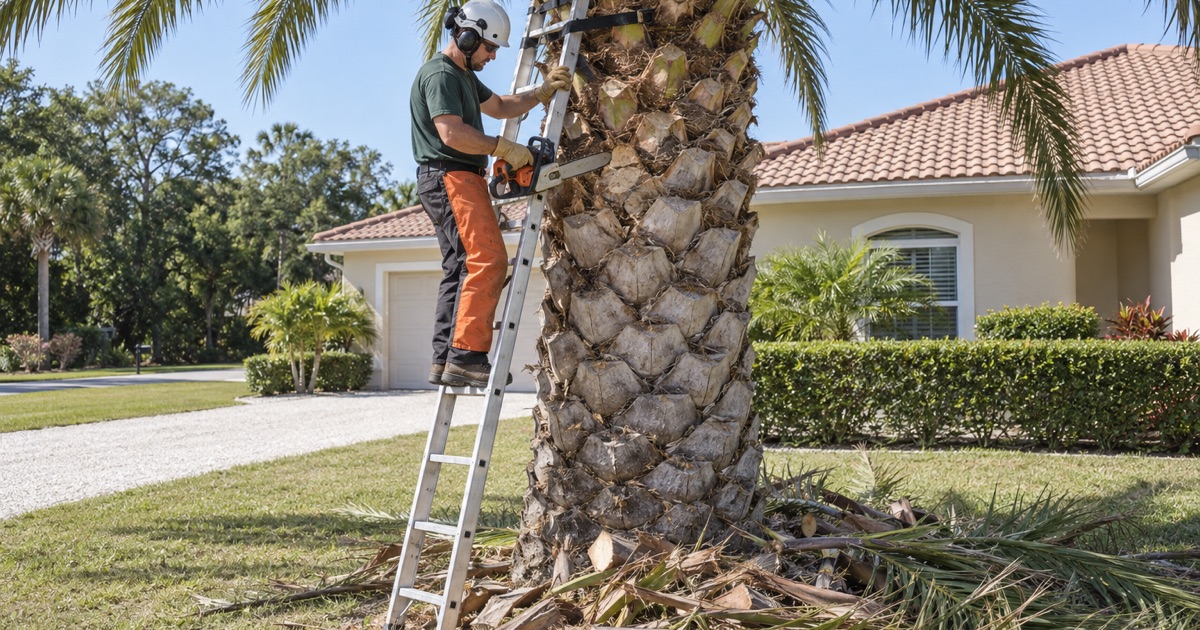
Everything a palm will ever be comes out of a single bud at the top of the trunk. Damage it with a spike, a cut into the crownshaft or a careless rigging line and the palm is finished even though it stays green for months. So our rigging paths stay clear of the spear, nobody spikes a trunk, and the bud area is treated as the one irreplaceable part of the plant.
What May Come Off, and What May Not
Dead fronds, hanging fronds, the seed stalks and the old leaf bases come off. Living green fronds stay, because each one is feeding that single bud, and the lowest green fronds are the ones a palm draws nutrients from as they age. We work to the shape the species actually grows rather than cutting everything above horizontal, which is the habit behind most of the damaged palms on this coast.
Hurricane Cuts and Hat Racking, Refused Outright
The pitch for a hurricane cut is that less canopy means less wind load. In practice it starves the bud, produces smaller and weaker fronds for years, and opens fresh wounds at the exact season the palmetto weevil is hunting for them. Hat racking a hardwood does the equivalent damage by a different route. Both are refused here on every species, and we will explain it at the quote rather than after.
Species, and What Each One Needs
Sabal Palmetto and the Frond Skirt
The cabbage palm carries costapalmate fronds and often a persistent skirt of dead fronds and boots down the trunk. Whether that skirt comes off is partly appearance and partly what lives in it, and removing boots below the green is optional rather than necessary. Those boots also wrap the trunk below grade, which is why a sabal’s real base diameter is frequently wider than it looks from the driveway.
Queen and Royal Palms
Queen palm is feather-leaved, fast, self-cleaning in theory and messy in practice, dropping heavy fronds and large fruit stalks that matter a great deal over a walkway or a car. It is also the species we most often find with frizzle top. Royal palm is feather-leaved on a smooth gray trunk under a heavy crownshaft, sheds enormous fronds cleanly, and needs the drop zone treated seriously rather than the palm pruned harder.
Mexican Fan Palms and Height
Mexican fan palm runs tall and slender with a fan frond and a thorned petiole, and height is the whole job: the crown ends up well beyond bucket reach and the trunk diameter never increases to match. That combination decides access, climbing method and whether a spider lift earns its place on the quote, and near the airfields in this service area it also raises a height question before it raises a preference.
Palm Disease and Deficiency
Frizzle Top Is a Manganese Deficiency
New fronds emerging small, frizzled and scorched at the tips, most visibly on queen and royal palms, is frizzle top, and it is a manganese shortage rather than a pathogen. Caught while the bud is still alive it is correctable through the soil, and normal fronds follow. Untreated it kills the bud, and the narrowed trunk laid down during the shortage never fills back out.
Lethal Bronzing and Spear Leaf Collapse
Lethal bronzing is a phytoplasma disease that works up a palm from the lower fronds, drops fruit prematurely and ends with the spear leaf collapsing, and nothing cures it once symptoms appear. Because the early signs overlap with deficiency, laboratory testing on trunk tissue is what settles it. We advise the test before a removal the whole street is going to see, since a wrong call here gets copied up the block.
Ganoderma Butt Rot and Thielaviopsis Trunk Rot
A shelf-shaped conk at the base is Ganoderma zonatum, and the lower trunk is already decayed by the time it is visible. Thielaviopsis trunk rot attacks higher up and can drop a crown or snap a trunk with little warning from the ground. Neither has a treatment to sell, both mean the palm is a hazard rather than a patient, and the site stays unsuitable for a replacement palm afterward.
Palm Removal and Replacement
Taking a Palm Down Whole or in Sections
With clearance underneath, a palm comes down in one controlled piece and that is the cheapest way to do it. Without clearance the trunk is sectioned from the top, which is slower and where the weight genuinely has to be managed, because palm trunk sections are far heavier than they look and do not break up on impact the way hardwood does.
The Root Ball and the Hole It Leaves
Palm roots form a dense fibrous mass near the trunk rather than large laterals running out through the yard, which makes the hole smaller in footprint and often deeper in feel. Grinding or digging it is quoted separately, and on a saturated lot the same water table that limits a hardwood stump grind limits this one, so we set the depth to the ground rather than to a brochure.
Replanting, and What the Site Will Take
If the palm came out because of Ganoderma, another palm in that spot is a poor idea regardless of species, and a broadleaf tree is the better replacement. Where the removal was for clearance or damage, the new palm wants to be offset from the old root mass and planted at the depth it grew at, because a palm set too deep declines slowly and nobody connects it to the planting a year later.
Our Step-by-Step Palm Trimming Process
1. Identify the Species and Read the Crown
Everything starts with what the palm actually is, then bud and spear condition, frond color and size, any penciling in the trunk, and whatever the last crew did to it. That determines whether this is maintenance, correction or removal.
2. Set the Drop Zone and the Access Method
Fronds and fruit stalks are heavy and fall fast, so the zone underneath is cleared and protected before anything comes off. Climb, bucket or spider lift is decided by height, trunk condition and what the ground will carry.
3. Cut Only What Should Come Off
Dead and hanging fronds, seed stalks, and loose boots where you want them gone. Green fronds stay, the crownshaft is not cut into, and the spear is left alone. No spikes go into a trunk we intend to leave standing.
4. Clear Down and Report What We Saw
Fronds are chipped or hauled, the area is blown clean, and you get a short plain note on anything we found in the crown, because a deficiency caught this visit is cheaper than the same palm next year.
- 20+ Years on This Coast
- Free Written Estimates
- Dated Condition Reports